
Learning Wing Chun vs Training Wing Chun: The Critical Difference
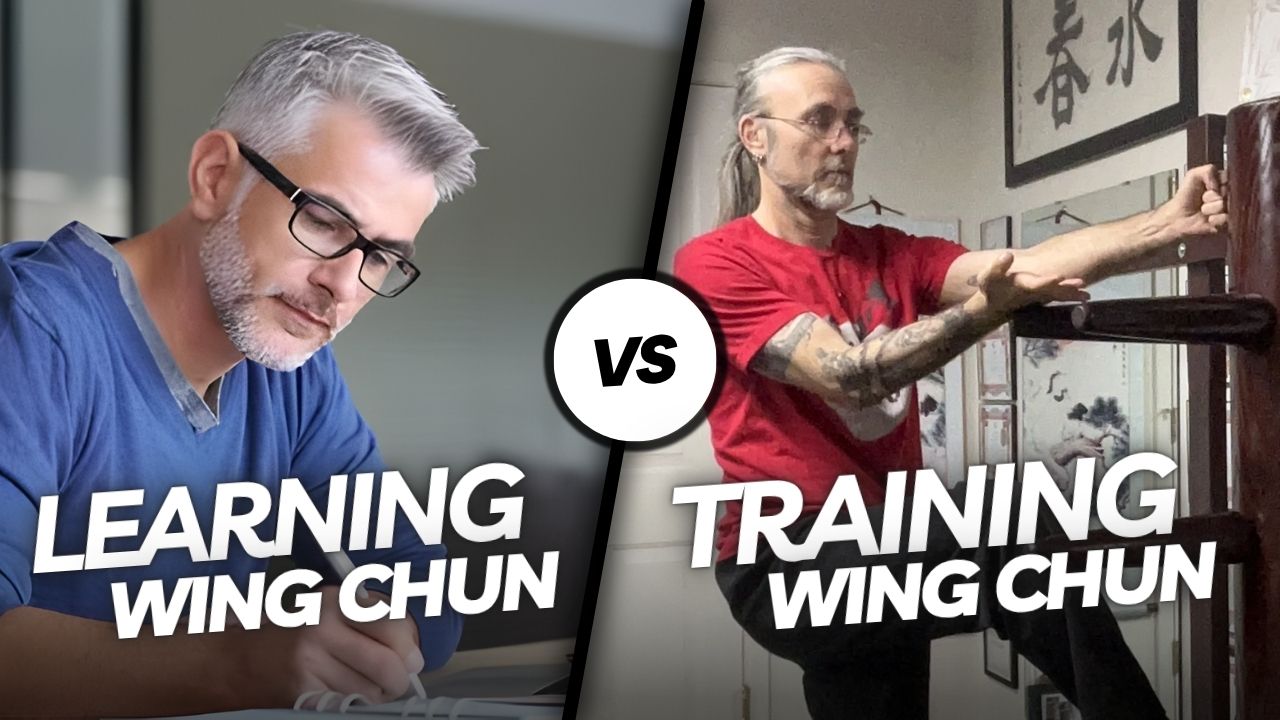
The Critical Difference Between Learning Wing Chun and Training Wing Chun
Information Is Not Transformation: Why Knowing Wing Chun and Doing Wing Chun Are Two Different Things
There is a particular kind of student who knows everything about Wing Chun.
He can tell you the names of all three empty-hand forms, trace the lineage from Ng Mui to Yim Wing Chun to Yip Man. He’s watched every YouTube breakdown of centerline theory, every slow-motion dissection of chain punching mechanics. He owns three books on Wing Chun training. He can explain simultaneous attack and defense, the economy of motion, the logic of a forward-oriented stance. Ask him about Chum Kiu and he’ll give you a lecture.
Put him in front of a Wing Chun training partner and he dissolves.
His stance is wide. His elbows flare. His punches drift off centerline before they’ve traveled six inches. His Tan Sao looks nothing like what he described five minutes ago. And the moment someone applies any real pressure — even light, cooperative pressure — his body has no idea what to do.
He knows Wing Chun. He just can’t do it.
This gap — between the map and the territory, between intellectual understanding and embodied skill — is one of the most important and most ignored problems in martial arts training. It is not unique to Wing Chun. But Wing Chun, with its emphasis on sensitivity, structure, and internal mechanics, makes the gap brutally visible. You cannot fake your way through Chi Sao. The body either knows, or it doesn’t.
The Seduction of Information
We live in an era of frictionless information. Anything you want to understand about Wing Chun can be found in minutes — explained, diagrammed, debated, demonstrated. This is genuinely wonderful. It is also quietly dangerous.
The danger is not that the information is wrong (though some of it is). The danger is that consuming information feels like learning. There is a cognitive reward — a small hit of satisfaction — that comes from understanding a concept. When something clicks intellectually, the brain registers progress. You feel like you’ve moved forward. You have not moved forward. You have moved sideways into a different room.
Understanding why the elbow should stay down in a Bong Sao is not the same as having an elbow that stays down. Understanding the theory of relaxed force is not the same as being able to generate it. Understanding that you should redirect rather than oppose force is not the same as a nervous system that redirects rather than opposes.
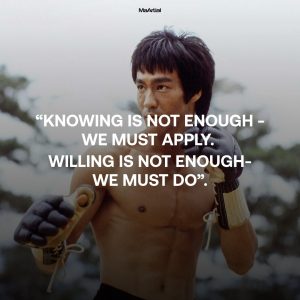 Information is not transformation. Knowledge is not skill.
This is worth sitting with, because the mind resists it. The mind prefers the comfortable fiction that if it understands a thing well enough, the body will follow. The body does not care what the mind understands. The body only knows what it has practiced — what it has rehearsed until the nervous system stopped needing permission to act.
The Mechanism of Real Learning
Skill in Wing Chun — or in anything requiring physical precision under pressure — is built through a process that has nothing to do with comprehension. It is built through repetition with feedback, over time, under conditions that gradually approach the real thing.
The nervous system is not a filing cabinet. You cannot place correct technique into it by reading about correct technique. You build neural pathways the same way water cuts channels in rock: through repeated passage, again and again, until the groove is deep enough that water flows there automatically.
This is why forms exist. Not to show you what Wing Chun looks like. Not to give you something to perform. Forms are a method of ingraining movement patterns into the body through deliberate, sustained repetition. Siu Nim Tao — the first form, the “little idea” — is not little in the sense of being simple or preliminary. It is little in the sense of being foundational, irreducible. Its purpose is not to teach you about arm positions. Its purpose is to make your arm positions correct without thinking, because thinking is too slow.
The student who watches form videos and believes he understands the form has mistaken the map for the territory. The map is useful. The territory is what you live in.
How Students Fool Themselves
The self-deception runs deeper than most students realize, and it takes several recognizable forms.
The conceptual collector. This student accumulates Wing Chun theory the way others collect stamps. He is always learning new concepts rather than deepening existing ones. He knows about the elements of good form, about Ip Man’s life, about the debate over combat sports vs traditional martial arts. He will talk to you about this at length. But his punch has not changed in two years because he has not spent two years fixing his punch — he has spent two years reading about punching.
The once-understood fallacy. This student had a breakthrough during class. Something clicked. He felt it — the structure was there, the relaxation was real, the energy flowed. He has been riding that memory ever since, assuming that because he once accessed the correct feeling, he now possesses it. He does not. A feeling accessed once is not a skill. A skill is a feeling you can access reliably, under pressure, without thinking. One good repetition is the beginning, not the end.
The substitute student. This student replaces practice time with adjacent activity. He watches instructional videos. He reads. He thinks about Wing Chun during his commute. He mentally rehearses techniques. All of this has some marginal value. None of it replaces the hours of actual physical practice that his nervous system needs. Mental rehearsal reinforces patterns that already exist in the body. It cannot create patterns that don’t exist there yet.
The critic without craft. This student has watched enough Wing Chun to develop strong opinions about what’s wrong with everyone else’s Wing Chun. He can identify flaws in his classmates’ technique, in his instructor’s lineage, in the videos he watches. His analytical eye is sharp. His own technique is undeveloped, because the time he spends analyzing is time he is not spending practicing.
What the Body Knows
 There is a humbling truth embedded in serious martial arts training: the body does not lie.
In Chi Sao or sparring, you cannot argue your way out of being controlled. You cannot explain why you should have defended your centerline while you are getting hit. The body reveals exactly what it has learned. Not what you think it has learned. Not what you wish it had learned. What it has actually, genuinely, physically internalized.
This is one of the gifts of Wing Chun as a practice — it provides constant, honest, inarguable feedback. When your structure collapses under light pressure, your structure was not as solid as you believed. When your sensitivity fails to register your partner’s intention before they move, your sensitivity is not what the books describe. When your Tan Sao spreads rather than knifes its way through, your Tan Sao is not yet good Wing Chun.
The body’s feedback is not unkind. It is precise. It tells you exactly where you are, which is the only information you need to know where to go next.
The Only Way Through is Hardwork
There is no shortcut through the gap between knowing and doing. There is only the work.
This means showing up to class when you don’t feel like it. It means drilling the basics long after the basics feel boring, because the basics are never boring when they’re not yet in your body. It means seeking pressure rather than avoiding it — asking your instructor to show you exactly where you broke and asking the discomfort to teach you something. It means going slowly enough that you can feel what’s correct, and then going again, and again, until correct becomes automatic.
It means caring more about being good at Wing Chun than about knowing things about Wing Chun. These are not the same ambition. One leads to the training floor. The other leads to the bookshelf.
The theory matters. Understanding the why behind a technique helps you practice it correctly, helps you remember it, helps you adapt it. But theory is a servant, not a destination. The destination is a body that has absorbed the principles so completely that they express themselves without permission — in a moment of pressure, in a moment of chaos, in the moment that counts.
Wing Chun is not a collection of ideas. It is a practice. That’s why someone who trains Wing Chun is called a Wing Chun practitioner. And a practice, by definition, is something you do.