
Raising Warriors in a World That Weakens Them
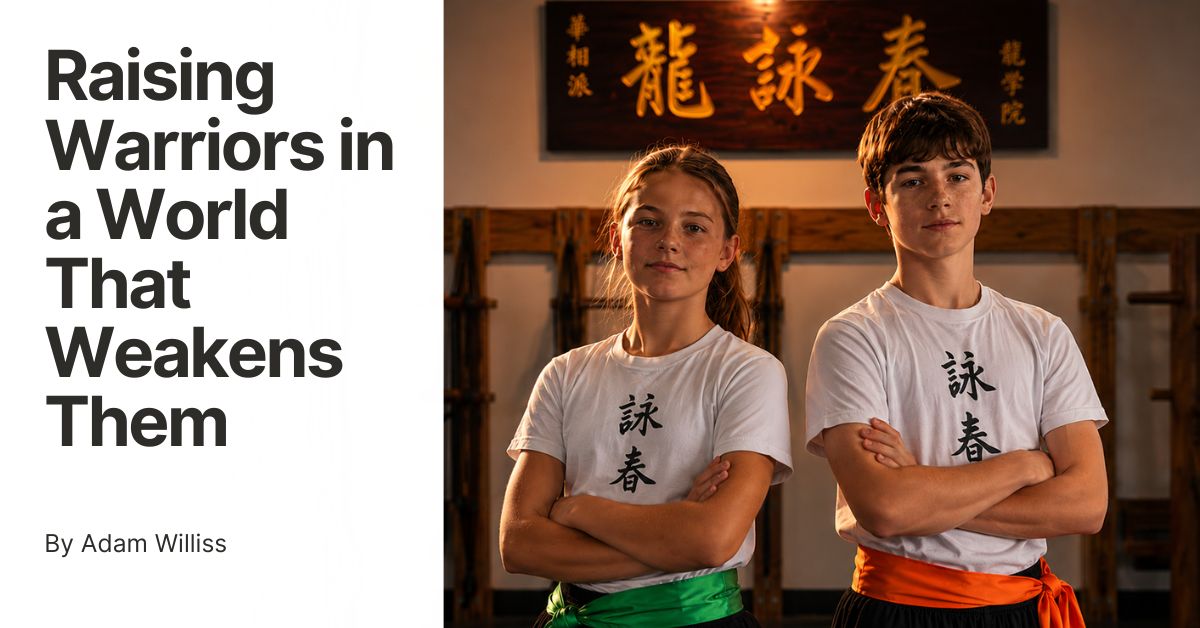
There’s a kid standing at the edge of the mat right now, somewhere, who won’t step on.
He’s not hurt. Nobody’s stopping him. He just doesn’t want to be bad at something in front of people, so he hangs at the line with his arms crossed, waiting for a reason to leave. Every parent reading this knows that kid. A lot of you are raising him. And the question that matters isn’t why he’s afraid — every kid is afraid of that. The question is what happens next.
Because that boy at the edge of the mat is going to become a man either way. That girl shrinking into the back row is going to grow up either way. The only thing in question is whether anyone guides the process, or whether we hand it to the phone, the algorithm, and a culture that has decided comfort is the highest good a child can be given.
I’ve been teaching long enough to tell you which way it goes when nobody guides it.
He becomes the twenty-two-year-old who quits the first job that corrects him. She becomes the seventeen-year-old who has never been told no and falls apart the first time a boy doesn’t pick her. He becomes the thirty-year-old man living in his childhood bedroom, telling himself he just hasn’t found his thing yet. None of them arrived there by accident. They were raised there, one rescue at a time, by parents who confused making their kid comfortable with loving their kid.
If that’s uncomfortable to read, good. It’s supposed to be.
So let me say the hardest thing in this entire article right now, plainly, and then spend the rest of it proving it to you.
The most loving thing you can do for your child is stop rescuing them.
Everything in you is going to fight that sentence. It sounds cold. It sounds like the opposite of love. Stay with me anyway, because by the time we’re done I think you’ll see it’s the most loving thing there is — and that the version of love most of us are practicing is quietly doing the damage.
Kids Are Weaker… a Lot Weaker. And We Did It to Them.
I’m going to be honest with you about what I see on the floor, because nobody else in your life is going to be.
Kids have gotten weaker. Not a little. A lot.
The children walking through my door today are softer — softer in the body, thinner in the will, quicker to fold the second something stops being fun. I’m not guessing and I’m not exaggerating for effect. I see it every day. Anyone who tells you it isn’t real is either not paying attention or too afraid of the parents to say it out loud.
But here is the part that actually matters, the part nobody wants to hear: we are doing this to them — not with one catastrophic failure, but with a million small mercies that each feel like love.
A child today can go an entire day without doing one hard thing, and most of you reading this know exactly how that happens, because you are the ones engineering it. The phone goes in the car so there’s no boredom on the ride. The class gets skipped because he had a long day at school. The chore gets done by you because it’s faster. The argument with the teacher gets had on the kid’s behalf because you don’t want them to feel singled out.
Every single one of those moments feels like love. Every single one of them is theft.
You are stealing from your child the only currency that builds an adult: the experience of doing something they didn’t want to do, and surviving it.
They Are Starving for Structure
Here is something most parents have backwards.
You think your child wants freedom. You think the loving thing is to let them choose, let them lead, let them set the terms — no rigid bedtime, no hard rules, no demands they didn’t sign up for. You think structure is the enemy of a happy childhood.
It’s the opposite. Children are starving for structure, and they will never once say it out loud. They’ll fight you on it. They’ll complain about it. And then watch what they actually do.
Watch a kid push on a boundary again and again — not because he wants it to break, but because he is desperate to find out if it’s real. A boundary that holds tells him someone is in charge, someone bigger than his own impulses is steering the ship, and that means he is safe. A boundary that crumbles tells him he is alone at the wheel of something he is far too young to drive. The most anxious children I have ever taught are not the ones with strict parents. They’re the ones who run their own houses. A kid with no rules isn’t free. He’s lost, and he knows it, and it terrifies him.
Discipline is not the thing you do to a child. It’s the thing you give a child so they can one day do it for themselves. A kid who has never been held to a standard cannot hold himself to one. That’s not a character flaw. It’s an empty space where the structure was supposed to go.
And the kids feel the absence. The boy who acts out for attention is asking, in the only language he has, for somebody to be in charge. The girl who melts down over nothing is telling you she has no internal floor to stand on, because nobody ever built her one. Their behavior is a request. We keep answering it with more comfort, when what they’re begging for is more spine.
We Let Them Quit on Themselves
The other half of this is the off-ramp. We let our kids quit.
We call it letting them find their passion. Soccer for a season, until it stops being fun. Piano for a month, until practice gets boring. Karate until the first belt test makes them nervous. We let them sample everything and commit to nothing, and we tell ourselves we’re respecting who they are.
What we’re actually teaching them is that commitment is optional and discomfort is a signal to leave.
Every time a kid hits the hard part of something — and the hard part is always where the growth lives — and we let them walk, we are not protecting them. We are teaching them to quit on themselves. We are wiring in the belief that when something gets difficult, that means it’s not for them. And that belief follows them straight into adulthood, into every job and marriage and dream they abandon the moment it stops being easy.
Growth does not happen in the part that’s fun. It happens in the part they want to quit. That’s not a reason to let them out. That’s the entire reason to keep them in.
The job of a parent is not to find the thing your child is naturally good at and comfortable with. It’s to place them into something hard, something real, and then refuse to let them quit on themselves when it gets uncomfortable — because that refusal is the single most important gift you will ever give them. They will hate you for it in the moment. They will thank you for it for the rest of their lives.
The Boy Who Couldn’t Lose
There was a kid — call him Marcus. Nine years old, sharp as anything, the kind of kid who was good at everything and knew it. School came easy. Sports came easy. He’d been told he was gifted by every adult in his life, and he believed them.
So he walked into my class expecting the mat to come easy too. It didn’t. And the first time I corrected his stance, something in his face just collapsed. He went quiet, jaw tight, eyes on the floor, and you could watch him decide right there that he hated this and he was done.
What I was actually watching was self-doubt. Real self-doubt, maybe for the first time in his life. Because here’s the secret about the kid who’s good at everything: he isn’t confident. He’s untested. His “confidence” is just a winning streak, and a winning streak is the most fragile thing a child can stand on, because the first real failure shatters it. Marcus had never been bad at anything, so he had no idea he could survive being bad at something. The moment he couldn’t, his whole sense of himself buckled.
His mother sat on the bench mortified. And here is the moment I want you to pay attention to, because this is where most parents lose their kid forever without realizing it.
She almost pulled him.
She almost did the thing. The “he’s just not enjoying it” call. The “maybe this isn’t his thing” pivot. The graceful exit that would have taught Marcus, in that single decision, that when something gets hard, the adults in his life will help him quit it. He would have learned the lesson cleanly. He would have applied it to every hard thing for the rest of his life. And his mother, who loved him, would have been the one who taught it to him.
She didn’t pull him. I don’t know what made her hold the line — maybe she’d already paid for the month — but she held it. The next week she practically carried him in.
What happened after that wasn’t a breakthrough. There was no movie moment. He kept getting corrected, and he kept hating it, and he kept showing up anyway, because his mother had stopped letting him off the hook. Show up, get corrected, run it again. Show up, get corrected, run it again. That’s discipline — not a feeling, just the willingness to come back and do the boring, humbling rep one more time. And somewhere in a few hundred of those reps, the hating it started to wear thin. One ordinary Tuesday I corrected him for the fiftieth time and instead of his face falling apart, he just reset his feet and ran it again. Like it was nothing.
That was the turn. And it happened because one adult, one time, refused to rescue him.
A year later Marcus is the steadiest kid in the room. Now he has real confidence — not the kind he was handed, the kind he built, which is the only kind that holds when life gets hard. He knows he can be bad at something and not die. He knows the wall is survivable. That’s not a martial arts skill. That’s mental toughness, and it is the foundation everything else in his life will be built on. His mother almost robbed him of it out of love.
That is how thin the line is. That is how casually we trade our children’s future for their short-term comfort.
The Counterfeit Warrior
There’s a reason your son would rather be in his room than anywhere else, and you already know what it is.
The game gives him everything a boy is built to crave — and gives it to him for free. Challenge. Mastery. Ranking up. A mission. Brothers on the headset who have his back. The feeling of being powerful, of being someone, of being a warrior. Every single hunger that was supposed to drive him out into the world, satisfied in twenty minutes, with no scraped knuckles and nothing real on the line.
That is not entertainment. That is a counterfeit. And it is the most dangerous thing in your house, because it doesn’t just waste his time — it feeds the exact hunger that was supposed to push him out into the world to become something real.
Look at what it’s actually doing to him while he sits there. It is rewiring what feels rewarding, dumping more dopamine into his brain than anything in the real world can match, until ordinary life — a book, a conversation, a walk, a sport — feels gray and slow and boring by comparison. It is shredding his attention, training him to need something new every few seconds, so he can’t sit still through anything that doesn’t flash and move. It is wrecking his sleep. It is handing him fake brotherhood — voices in a headset that vanish the instant the console turns off — in place of real friends who can look him in the eye. And when you try to take it away, you don’t get a disappointed kid. You get withdrawal. You get rage. You get a level of meltdown that, if you saw it in an adult over any other substance, you would call by its real name.
And here is the part a martial arts father feels in his gut. While his son is leveling up an avatar, building a powerful body on a screen, his own body is going soft. The real kid behind the controller can’t do ten honest pushups. Can’t run without gasping. Can’t hold a plank, take a fall, throw a real punch with real intent behind it. He is the master of a warrior who doesn’t exist, and a stranger to the one in the mirror.
He can’t become a warrior because he already feels like one. The counterfeit got there first.
And here is what I need you to understand: he is not lazy. He is not broken. He is a boy with a warrior’s hunger and no real place to spend it, so he spends it on the only thing offering. That is not his failure. That’s ours. We handed him a simulation of manhood and then wondered why he never went looking for the real one.
Warriors Get Forged, Not Born
I use the word warrior on purpose, and I want to be clear what I don’t mean. I don’t mean violent. I don’t mean hard. I don’t mean a kid who is spoiling for a fight. A real warrior is the last person looking for one.
I mean a person who can stay centered when everything around them is pulling them apart. Who can be corrected without crumbling. Who can lose without quitting. Who can feel fear and move anyway. That is mental toughness, and that child is not born with it — I have never once seen it arrive pre-installed. It gets built, rep by rep, through exactly the discomfort our culture works so hard to spare them from.
That centeredness changes how a kid moves through the entire world, and it starts with how they carry themselves. A bully does not pick the calm kid. Bullies hunt for fear, for the flinch, for the child who already believes he’s a target — and they read it in a heartbeat, in the shoulders, in the eyes that won’t meet theirs. A kid who has stood in real discomfort and not broken simply doesn’t carry that signal anymore. Most of the time he never has to throw a hand. The whole problem walks right past him and goes looking for someone who hasn’t done the work. And the kid who does have skill and is steady in himself? He doesn’t become a bully either. He’s got nothing to prove. The boy who needs to make others small is the one who feels small inside. Fix the inside and the whole thing dissolves from both ends.
This is also where leadership comes from, and it does not come from a title. It comes from being the calmest person in the room when things go sideways. Every other kid is panicking, and there’s one who’s steady — and the rest of them turn to that one without anyone telling them to, because human beings instinctively follow whoever isn’t afraid. You cannot teach a child to lead with a worksheet. You build the steadiness first, through pressure and discipline and a thousand small hard things, and the leadership grows out of it on its own.
And none of this splits down boy and girl lines the way people expect. Every kid who walks in is carrying the same thing — a quiet, growing suspicion that they might not actually be capable of anything hard, because nobody in their life has ever asked them to find out. They want to be tested. They are begging to be tested. They just need an adult to take them seriously enough to ask something real of them, and to hold the line when they push back.
If you don’t ask it of them, the world will. The difference is the world will not be patient about it. The world will hand them their first real test at twenty — in a job, in a relationship, in a moment when the wheels come off — and they will find out then what they’re made of. Except they won’t be made of anything yet, because nobody built it into them when there was still time.
The Girl Who Disappeared
If Marcus came in too big, Ava came in trying not to exist.
Eleven years old, and she apologized for everything. Bumping a pad. Asking a question. Taking up a square foot of space she clearly felt she had not earned. When she threw a strike it was soft, half-pulled, like she was sorry to be hitting at all.
I see this in girls constantly, and I am going to say the part most people will not: a lot of these girls learned to be small from watching the women in their lives be small. From watching their mothers apologize for opinions. From watching their fathers reward “good girl” behavior and get uncomfortable with anything louder. By eleven, the lesson is already deep in their bones. Ava did not shrink because she was born small. She shrunk because her environment trained her to.
The turn for her came in a self-defense drill, the kind where I make them use their voice — an actual loud, sharp NO with the strike behind it. The first few times, nothing came out. Just a whisper and that apologetic little laugh. So we stayed on it. And then one day, out of nowhere, she let a real one go. Full voice. Full strike. The sound of it surprised her more than it surprised me. I watched her flinch at her own power, like she had opened a door she did not know was hers to open.
She did not transform overnight. But that crack let the light in. These days Ava walks into the room instead of slipping into it. She makes eye contact. She says no and means it, and not just on the mat.
And here’s what that did that no parent expects from a self-defense class: it made her invisible to exactly the wrong people. The girl who used to apologize for existing was a target — for the mean girls, for the boys who push, for everyone who hunts for someone who won’t push back. The girl she is now doesn’t read as prey anymore. The bullying didn’t get handled with a meeting or a policy. It got handled because Ava stopped walking through the world like someone waiting to be pushed. Her mother told me the change she cares about has nothing to do with throwing a punch — it’s that her daughter stopped apologizing for being in the room.
The strongest girls I have ever taught were never the loudest. They were the most grounded. The ones who stopped asking permission to take up space.
“I Just Want Them to Be Happy”
I am not trying to build perfect kids. I am not even trying to build happy ones, and I will tell you why.
“I just want them to be happy” is the most damaging sentence in modern parenting. It sounds loving. It functions as an excuse to never ask anything hard of your child. It justifies every quit, every skip, every rescue. And it produces adults who are not happy — adults who are anxious, fragile, lost, and stunned that the world will not keep treating them the way their parents did.
I am trying to build kids who can keep going when it gets hard. Kids who have already met failure, frustration, and their own fear in a safe place, so that when life hits them with the real versions later — and it will, and you cannot stop it — they have something to stand on. Rejection is coming for them. Heartbreak. Pressure. The day they fail at something that actually matters. None of that is optional. The only thing optional is whether they are ready for it.
A kid who has been rescued from every difficulty arrives at adulthood with no foundation at all. A kid who has been guided through difficulty arrives with bedrock. You are choosing, right now, which one yours is going to be. Not on a special day. Not at some future inflection point. Today. In what you let them quit. In what you let them avoid. In what you ask of them, and whether you mean it.
The Most Loving Thing You Can Do Is Stop Rescuing Your Kid
I told you at the start I’d prove it. Here it is.
We have to be honest about what the rescuing actually is, because it does not come from love. It feels like love. It wears the face of love. But when you trace it back to the root, the instinct to swoop in and make your child’s discomfort disappear comes from somewhere else: it comes from fear. Fear of their tears. Fear of being the bad guy. Fear of the tantrum in the store, the slammed door, the kid who says I hate you. Fear of watching them struggle and feeling, in your own chest, the helplessness of not fixing it.
So we fix it. We rescue. And we tell ourselves it was love, because that’s a much more comfortable story than the truth — that we couldn’t tolerate our own discomfort, so we robbed them of theirs.
Real love is harder than that. Real love is willing to be hated for an afternoon. Real love sits on its hands while a child struggles with something difficult, because it understands that the struggle is the gift and the rescue is the theft. Real love says no and means it. Real love holds the line on the bad night, the tired night, the night it would be so much easier to fold — because real love is playing a longer game than this evening’s peace.
Think about the mother who almost pulled Marcus off the mat. The loving thing, in the moment, looked like taking him home. Sparing him. Letting him off the hook he so badly wanted off of. And the actual loving thing — the thing that built the man he’s becoming — was to sit there and let him hate it, and bring him back the next week, and the next. She had to love him enough to let him suffer something small now so he wouldn’t be crushed by something large later. That is the whole job, right there, in one woman on a bench deciding not to flinch.
This is the part I need you to hold onto: you are not being cruel when you let your child face a hard thing. You are not failing them when they cry and you don’t cave. You are doing the single most loving thing available to a parent, which is to value who they will become over how they feel for the next ten minutes. Comfort is the cheap love. It’s the love that asks nothing of you and gives nothing to them. The expensive love — the love that costs you the kid’s approval tonight and pays them back for a lifetime — is the love that lets them struggle, and stays close while they do.
Stop rescuing your kid. Not because you don’t love them. Because you do.
They’re Becoming Someone Right Now
Here is the part I want you to actually sit with.
Your child is becoming someone today. Not someday — today. In the small choices about whether hard things are worth doing. In whether the adults in their life rescue them or steady them. In whether anyone in this world ever asks them to find out what they are made of.
That formation is happening whether you steer it or not. The screen is steering it. The game is steering it. The algorithm is steering it. Your exhaustion is steering it. The path of least resistance is steering it, every single day, in the absence of you. And one day, sooner than you think, you are going to meet the adult version of the child you did not quite get around to raising on purpose — and you will know, in a way you cannot unknow, exactly when it was too late.
The answer will not be one dramatic day. It will be all the ordinary ones. The class you let them skip. The hard thing you let them quit. The line you did not hold because you were tired. The I’ll get to it when they’re older that turned out to mean never.
You do not have to enroll them in martial arts. That is not the point of this. The point is that someone — you, ideally — has to start asking real things of them, holding real lines, and loving them enough to stop rescuing them. The rest follows.
Because in the end, whatever they become, character will always matter more than ability. And character is not given. It is built. By somebody. On purpose.
The only question left is whether that somebody is going to be you.